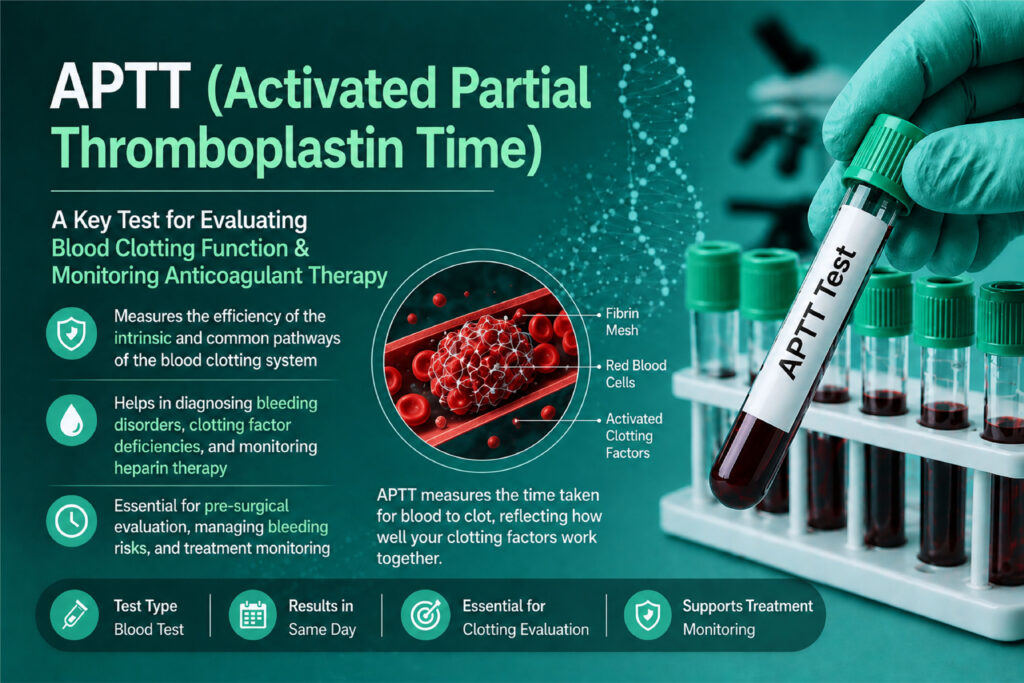
Definition
The Activated Partial Thromboplastin Time (aPTT) is a cornerstone diagnostic test in clinical coagulation laboratories. It measures the integrity of the intrinsic and common pathways of the coagulation cascade. For medical laboratory professionals and students, understanding aPTT is essential for identifying inherited bleeding disorders, assessing liver function, and monitoring anticoagulant therapy.
Clinical Significance
The clinical utility of aPTT fundamentally relies on its ability to evaluate the functional integrity of the intrinsic (XII, XI, IX, VIII) and common (X, V, II, I) clotting pathways. When any of these functional components are altered, the assay reflects it through a deviation from the baseline reference range.
1. Causes of a Prolonged aPTT (Delayed Clotting)
A prolonged aPTT indicates that fibrin clot formation is taking longer than standard physiological parameters. This delay generally falls into three clinical categories: congenital factor deficiencies, acquired factor deficiencies, or circulating biochemical inhibitors.
A. Congenital Coagulation Factor Deficiencies
When a patient is born lacking a specific protein in the cascade, the aPTT remains prolonged because the sequential activation steps are stalled.
Hemophilia A (Factor VIII Deficiency): An X-linked recessive disorder. The aPTT is highly sensitive to Factor VIII drops, usually lengthening significantly when factor levels fall below 30% to 35% of normal functioning levels.
Hemophilia B / Christmas Disease (Factor IX Deficiency): Clinically indistinguishable from Hemophilia A without a specific factor assay.
Hemophilia C (Factor XI Deficiency): Primarily seen in populations of Ashkenazi Jewish descent; unlike Hemophilias A and B, the severity of aPTT prolongation does not always correlate perfectly with the patient’s actual clinical bleeding risk.
Factor XII (Hageman Factor) Deficiency: A profound laboratory paradox. A lack of Factor XII leads to a markedly prolonged aPTT, yet these patients experience zero clinical bleeding tendency because alternative pathways bypass Factor XII in vivo.
B. Acquired Pathological Deficiencies
Vitamin K Deficiency or Warfarin Therapy: While the Prothrombin Time (PT) is far more sensitive to Vitamin K status (due to Factor VII’s short half-life), severe or prolonged Vitamin K depletion will eventually deplete Factors IX, X, and II, resulting in a prolonged aPTT alongside the elevated PT.
Disseminated Intravascular Coagulation (DIC): In acute DIC, systemic microvascular clotting rapidly consumes platelets and clotting factors (especially V and VIII). As consumption outpaces hepatic synthesis, the aPTT becomes progressively prolonged.
Hepatic Coagulopathy: Because the liver synthesizes nearly all coagulation factors, severe end-stage liver disease leads to decreased production of the intrinsic and common pathway proteins.
C. Circulating Inhibitors (The Autoimmune and Therapeutic Elements)
Unfractionated Heparin (UFH) Therapy: UFH binds to antithrombin III (ATIII), changing its shape to accelerate the inactivation of Thrombin (IIa) and Factor Xa. Because these factors are vital pillars of the intrinsic and common pathways, the aPTT is the clinical tool of choice to adjust heparin dosing safely.
Lupus Anticoagulant (LA) / Antiphospholipid Syndrome: LA antibodies target the phospholipid-protein complexes required for coagulation complexes to form. In the test tube, they block the reagent’s phospholipids, causing a false prolongation. In the patient’s body, however, they increase the risk of inappropriate blood clots (thrombosis).
Specific Factor Inhibitors (e.g., Acquired Hemophilia A): Autoantibodies can spontaneously develop against specific clotting factors—most commonly Factor VIII. This represents a clinical emergency, as it leads to severe, unpredictable hemorrhages.
2. Causes of a Shortened aPTT (Accelerated Clotting)
While a long aPTT gets immediate attention, a shortened aPTT (clotting faster than the normal reference interval) also provides critical clinical insight. It is typically a indicator of a systemic hypercoagulable state.
Acute Phase Reactions: Physical trauma, severe inflammation, advanced malignancy, or major surgery can trigger an acute phase response. The liver overproduces procoagulant proteins—particularly Factor VIII and Fibrinogen—which shortens the overall clotting time in vitro.
Disseminated Malignancy: Many solid tumors secrete tissue factor or microvesicles that continuously trigger trace amounts of thrombin, priming the intrinsic system to react rapidly in the lab analyzer.
Pregnancy: The third trimester of pregnancy induces a natural hypercoagulable state as the body prepares for the vascular challenges of delivery, frequently causing a physiological shortening of the baseline aPTT.
The Clinical Decision Matrix
To assist lab professionals in translating an anomalous aPTT result into actionable diagnostic guidance, use this clinical reference pathway:
| aPTT Status | PT Status | Platelet Count | Primary Clinical Suspects |
| Prolonged | Normal | Normal | Hemophilia A/B/C, Factor XII deficiency, Heparin contamination, Lupus Anticoagulant. |
| Prolonged | Prolonged | Normal | Common pathway factor deficiency (X, V, II, I), severe Vitamin K deficiency, Warfarin treatment. |
| Prolonged | Prolonged | Decreased | Disseminated Intravascular Coagulation (DIC), advanced Liver Cirrhosis. |
| Shortened | Normal / Short | Normal / Elevated | Acute phase response, underlying malignancy, high-estrogen states (pregnancy/OCPs). |
Methods & Principle
To consistently deliver highly precise results in a clinical hematology department, a lab professional must master both the biochemical cascade occurring inside the cuvette and the physical detection technologies used by modern coagulometers.
Let’s break down the exact analytical principle and step-by-step methodologies used to determine the Activated Partial Thromboplastin Time (aPTT).
1. The Core Analytical Principle of aPTT
The aPTT is a two-stage, plasma-based clotting assay that mimics the in vivo intrinsic coagulation pathway under strictly controlled in vitro conditions.
Because patient blood is collected in sodium citrate (which chelates, or binds, calcium ions), coagulation is halted in the test tube. The aPTT assay artificially restarts this clock in a controlled sequence:
The Two Critical Reagent Elements:
The Activator (Contact Phase Initializer): Reagents use negatively charged particulate substances like silica, ellagic acid, kaolin, or celite. These provide a high-surface-area matrix that converts the proenzyme Factor XII into its active enzymatic form (XIIa), bypassing the biological need for tissue damage or platelets to start the cascade.
The Partial Thromboplastin (Phospholipid Template): Crucially termed “partial” because it contains phospholipids only, completely lacking the Tissue Factor required to trigger the extrinsic system (Factor VII). These phospholipids (often derived from soy, rabbit brain, or synthetic blends) substitute for the missing cellular membranes of platelets, providing the binding sites for the assembly of the tenase and prothrombinase enzyme complexes.
2. Step-by-Step Laboratory Methodology
While modern automated analyzers manage these steps internally via mechanical arms and fluidics, manual and semi-automated techniques follow this exact procedural pipeline.
1.Sample Preparation (Centrifugation):Within 1 hour of collection.
Centrifuge the 3.2% buffered sodium citrate tube at 1500 \times g for 15 minutes to yield Platelet-Poor Plasma (PPP, platelet count < 10x 10^9L).
2.Reagent Aliquot and Reconstitution:Pre-warming phase.
Pipette 100uL of patient PPP into a clean reaction cuvette. Aliquot the aPTT reagent and the 0.025M Calcium Chloride (CaCl2) starter solution into separate reservoirs, allowing them to warm to 37C inside the analyzer incubation block.
3.Activation and Incubation:Exactly 3 to 5 minutes (Reagent dependent).
Add 100uL of pre-warmed aPTT reagent directly to the patient plasma. Program the system to incubate for exactly the time specified by the manufacturer (typically 180 to 300 seconds). This allows optimal activation of Factors XII and XI without exhausting the system.
4.Recalcification (The Starter Shot):Time zero.
Forcefully inject 100uL of pre-warmed 0.025M CaCl2 into the mixture. This re-introduces the free calcium ions (Factor IV) required for the remaining enzymatic assembly steps. Start the stopwatch immediately at the moment of injection.
5.Endpoint Detection:Result recording.
Monitor the solution continuously. The analyzer stops the internal timer the exact millisecond a gel-like fibrin clot lattice materializes. Record this value in seconds.
3. Analyzer Clot Detection Systems
Modern clinical laboratories utilize two primary methodologies to detect the exact endpoint of fibrin formation. Knowing which system your analyzer utilizes is crucial for recognizing sample interference.
A. Optical Detection Systems (Photo-Optical)
Mechanism: A light source sends a specific wavelength (typically 405nm or 660nm) directly through the cuvette onto a photodetector. As the calcium triggers the conversion of soluble fibrinogen into insoluble, cross-linked fibrin polymers, the sample becomes turbid.
Endpoint: The sudden drop in transmitted light intensity (or increase in scattered light) signals the exact moment of clot completion.
The Technical Catch: This method is susceptible to false readings or flags if the plasma is highly icteric (bilirubin interference), lipemic (milky chylomicrons scatter light), or hemolyzed (free hemoglobin absorbing light at 405nm).
B. Mechanical Detection Systems (Viscosity-Based)
Mechanism: An electromagnetic field oscillates a small, sterile steel ball or magnetic bead back and forth across the bottom of the cuvette.
Endpoint: As fibrin strands build up, the viscosity of the plasma increases. This physical resistance slows down or alters the rhythmic movement of the steel ball. The mechanical sensor detects this change in kinetic amplitude instantly.
The Advantage: Completely immune to optical interferences. Lipemic, icteric, or hemolyzed samples can be processed seamlessly without risking analytical artifacts.
Reagent Sensitivity: A Vital Professional Nuance
Not all commercial aPTT reagents are created equal. Manufacturers vary the source of the phospholipids and the type of activator to deliberately tailor sensitivities:
Lupus Anticoagulant-Sensitive Reagents: Feature a low phospholipid concentration. Because lupus anticoagulants compete for binding sites on phospholipids, reducing the available concentration makes the reagent highly sensitive, resulting in prominent prolongations when these pathogenic autoantibodies are present.
Heparin-Insensitive Reagents: Formulated with higher phospholipid concentrations or alternative activators to make them highly robust during factor deficiency screening, even if trace heparin is present in the sample line.
Specimen Requirements
Because coagulation testing measures dynamic enzymatic reactions, the integrity of the aPTT result is determined almost entirely before the sample ever reaches the analyzer. More than 70% of analytical errors in hemostasis testing stem from poor pre-analytical handling.
To protect specimen quality and guarantee clinical accuracy, the following strict specimen requirements must be enforced.
1. The Collection Container & Anticoagulant
Tube Type: Plastic or siliconized glass tubes with a light blue top.
Anticoagulant Selection: 3.2% buffered sodium citrate (equivalent to 0.105M or 0.109M) is the global standard endorsed by CLSI.
Why 3.2% over 3.8%? Older 3.8% formulations contain a higher concentration of citrate which can overly dehydrate cells and bind excessive calcium during the analytical phase. This frequently causes false prolongations in borderline factor deficiencies or when monitoring low-dose heparin.
2. The Critical 9:1 Blood-to-Anticoagulant Ratio
Coagulation assays require an exact proportion of liquid anticoagulant to patient plasma. Citrate acts by chelating (binding) free ionized calcium. If this balance is skewed, the entire test is invalidated.
The Target: 9 parts whole blood to 1 part sodium citrate.
Acceptable Variance: Tubes must be filled within pm 10% of the manufacturer’s stated fill line.
The Danger of Underfilling (Short Draws): If a tube is filled below 90% capacity, the relative volume of citrate is too high for the small volume of plasma. When calcium chloride is added during the test, the excess citrate binds it up immediately, causing a falsely prolonged aPTT.
Mixing Protocol: Invert the tube gently 3 to 4 times immediately after collection. Vigorous shaking causes mechanical hemolysis, while inadequate mixing leads to micro-clot formation—both require immediate sample rejection.
3. Order of Draw and Venipuncture Guidelines
The Order of Draw: Coagulation tubes must be drawn before other additive-containing tubes (like SST/Gel tubes, EDTA, or Fluoride) to prevent chemical cross-contamination.
Winged Collection Sets (Butterflies): If a butterfly needle is used, a discard tube must be filled first. The air inside the butterfly’s long plastic tubing takes up volume; if the blue tube is attached first, this air space prevents the tube from reaching its full 9:1 vacuum fill capacity.
Line Draws (Intravenous Catheters): Avoid drawing aPTT samples from indwelling lines if possible. If an IV line must be used, flush it with saline and discard at least 5 mL of blood or 6 times the dead-space volume of the catheter before filling the citrate tube to eliminate heparin-flush contamination.
4. Processing and Centrifugation (Platelet-Poor Plasma)
To obtain reliable aPTT results, the patient’s plasma must be processed into Platelet-Poor Plasma (PPP).
Centrifugation Parameters: Spin at 1500 x g for 15 minutes at room temperature (15C to 25C).
The Platelet Threshold: The resulting supernatant plasma must have a residual platelet count less than 10 x 10^9L.
Why it matters: Platelets contain Platelet Factor 4 (PF4), a potent heparin-neutralizing protein. If a sample contains excess platelets and sits before testing, PF4 will leak out, neutralize any therapeutic heparin present, and generate a falsely shortened aPTT.
5. Stability, Storage, and Transport Temperature
The factors evaluated by the aPTT (specifically Factor VIII and Factor V) are highly labile and degrade rapidly at room temperature.
| Storage Condition | Unfractionated Heparin (UFH) Samples | Non-Heparinized (Routine) Samples |
| Room Temp (15-25C) | Centrifuge and test within 2 hours | Test within 4 hours (keep capped) |
| Refrigerated (2-8C) | Do not refrigerate (causes cold activation of Factor VII/platelets) | Do not refrigerate if testing within 4 hours |
| Long-Term Frozen (-20C) | Stable up to 2 weeks (plasma separated from cells) | Stable up to 2 weeks (plasma separated from cells) |
| Ultra-Deep Frozen (-70C) | Stable up to 6 months | Stable up to 6 months |
Thawing Protocol: Frozen samples must be thawed rapidly in a water bath at 37C for 5 to 10 minutes. Slow thawing causes the formation of cryoprecipitate, which strips out Factor VIII and fibrinogen, ruining the test matrix.
Complete Sample Rejection Criteria Checklist
Always reject and document samples displaying any of the following pre-analytical complications:
Visible Clots: Any visible micro-clots or fibrin threads upon inspection with an applicator stick.
Inadequate Volume: Any tube filled under 90% or over 110% of the vacuum fill line.
Gross Hemolysis: Hemolyzed plasma releases intracellular clotting triggers, prematurely activating the cascade and falsely shortening or invalidating the optical endpoint.
Incorrect Tube Type: Samples collected in EDTA (lavender top) or Heparin (green top) tubes. EDTA binds calcium irreversibly, making it impossible to recalcify the sample in the analyzer.
Exceeded Time Window: Routine samples older than 4 hours or heparinized samples older than 2 hours that have remained un-centrifuged.
Reference Ranges & Clinical Interpretations
In the clinical coagulation laboratory, establishing reference intervals and managing critical thresholds are highly regulated processes. Because reagents and instrumentation vary widely, an elevated or depressed Activated Partial Thromboplastin Time (aPTT) must be interpreted through a structured framework.
1. Establishing the aPTT Reference Range
There is no universal, single normal value for the aPTT. According to CLSI H47-A2 guidelines, every laboratory must establish its own unique geometric mean and reference interval.
How a Lab Establishes the Reference Range:
Sample Size: A minimum of 20 to 40 verified healthy individuals (ideally 120 for full robust statistical verification) representing an equal distribution of biological sexes must be sampled.
The Window: The standard reference interval represents the central 95% confidence interval of this healthy population (typically calculated as the mean +- 2 standard deviations).
Standard Benchmark Range: While individual labs differ based on reagent formulations (such as silica vs. ellagic acid activators), a typical adult reference range is 25.0 to 35.0 seconds.
Crucial Life-Stage Variations
Coagulation factors change dynamically with age. A lab professional must never apply adult reference ranges to pediatric or geriatric cohorts blindly.
Neonates and Infants: Healthy newborns routinely exhibit a prolonged aPTT—often ranging between 40.0 and 55.0 seconds. This is a physiological phenomenon known as developmental hemostasis. Levels of the contact factors (Factors XII, XI, Prekallikrein, and High-Molecular-Weight Kininogen) along with the vitamin K-dependent factors are significantly lower at birth and take up to six months to mature to adult baselines.
Pregnancy: During a healthy third trimester, the maternal liver increases production of procoagulant factors (especially Factor VIII and Fibrinogen) as a physiological hedge against postpartum hemorrhage. This hypercoagulable shifts the normal reference range downward, resulting in a physiological shortening of the baseline aPTT.
2. Clinical Interpretations: The Diagnostic Matrix
When a patient’s aPTT falls outside the established institutional normal window, the laboratory professional works alongside the clinical team to isolate the underlying cause.
Extended Clinical Interpretation Breakdown
| Clinical Finding | Pathophysiological Mechanism | Key Diagnostic/Troubleshooting Action |
Prolonged aPTT (Normal PT) | Deficiency in the Intrinsic Pathway Factors VIII, IX, or XI are functionally below the 30–35% threshold needed to maintain standard kinetic clot timing. | Perform a 1:1 Mixing Study. If the sample corrects, run specific single-factor activity assays. |
Prolonged aPTT (Normal PT) | The Factor XII Laboratory Paradox A complete deficiency of Hageman Factor (XII) creates an extreme prolonged aPTT in vitro, but the patient exhibits zero bleeding risk in vivo. | Identify Factor XII levels to prevent unnecessary surgical cancellations or delays. |
Prolonged aPTT (Normal PT) | Circulating Inhibitors Presence of therapeutic Unfractionated Heparin (UFH), a specific autoantibody (like anti-Factor VIII), or a Lupus Anticoagulant (LA). | Perform a 1:1 Mixing Study. Failure to correct points to an inhibitor. Run a Dilute Russell’s Viper Venom Test (dRVVT) to check for LA. |
Prolonged aPTT (& Prolonged PT) | Common Pathway Defects or Global Coagulopathy Deficiencies in Factors X, V, II (Prothrombin), or I (Fibrinogen). Also caused by advanced liver disease, severe Vitamin K deficiency, or acute DIC. | Assess platelet counts, D-dimer levels, and fibrinogen levels to screen for acute consumption states. |
| Shortened aPTT | Hypercoagulable/Acute Phase States Elevated levels of Factor VIII or Fibrinogen due to systemic inflammation, tissue injury, active malignancy, or pregnancy. | Verify that the sample is free of pre-analytical micro-clots which can falsely use up clotting time. |
3. Therapeutic Ranges: Monitoring Unfractionated Heparin (UFH)
For patients undergoing treatment for thromboembolic disease via UFH infusions, the aPTT is tracked around the clock to adjust dosage.
The Traditional Benchmark: Historically, the therapeutic target was defined as an aPTT ratio of 1.5 to 2.5 times the mean of the laboratory’s normal range.
Modern Calibration Standards: Because modern reagents are highly variable, relying on a fixed multiplier can lead to dangerous over- or under-anticoagulation. Laboratories must calibrate their specific aPTT reagent lots directly against therapeutic heparin levels.
The Gold Standard Calibration: The aPTT therapeutic range should correspond precisely to an Anti-Xa plasma concentration of 0.3 to 0.7 IU/mL (measured via chromogenic anti-Xa assays).
4. Critical Action Thresholds (Panic Values)
Coagulation values that exceed certain boundaries represent immediate, life-threatening risks for spontaneous hemorrhage or profound therapeutic overdose.
 Laboratory Critical Value Notification Protocol
Critical Value Threshold: Any non-therapeutic or unexpected aPTT value $> 70 \text{ to } 100 \text{ seconds}$ (dependent on institutional safety policies).
Immediate Actions Required:
Immediate Visual Inspection: Check the blue-top vacuum tube for micro-clots using a wooden applicator stick, check for underfilling, and check the analyzer for any flag symbols (lipemia/hemolysis).
Rerun the Specimen: Rapidly repeat the test to rule out an individual instrument module malfunction.
Direct Contact Notification: Call the ordering physician, nurse in charge, or intensive care unit immediately. Read back the patient’s name, medical record number, and exact aPTT value. Document the date, exact time, and name of the health professional who accepted the critical verbal report in the Laboratory Information System (LIS).
Quick Stats
| Feature | Details | Critical Lab Insights |
| Test Type | Coagulation / Hemostasis Screen | A vital indicator of the intrinsic (XII, XI, IX, VIII) and common (X, V, II, I}) coagulation pathways. It serves as the primary gateway for diagnosing hemophilias and monitoring heparin therapy. |
| Sample Type | Platelet-Poor Plasma (PPP) | Collected in 3.2% Buffered Sodium Citrate (Light Blue Top). Must be centrifuged at 1500 x g for 15 minutes to reduce platelet counts to <10×10^9L to prevent Heparin neutralization. |
| Testing Method | Recalcification Clotting Assay | Utilizes a two-stage method combining contact activators (e.g., silica, ellagic acid) and partial thromboplastin (phospholipids). Clotting is timed following the introduction of 0.025M CaCl2. |
| Primary Metric | Clotting Time in Seconds | Measured dynamically using photo-optical (turbidity) or mechanical (viscosity) endpoint detection. Results indicate the exact time required to form a stable fibrin lattice. |
| Fasting Required? | No | Non-fasting. However, gross lipemia, icterus, or hemolysis can significantly interfere with optical detection channels, requiring a mechanical detection system fallback. |
| Standardization | CLSI H47-A2 / Local Anti-Xa | No universal standard exists due to reagent variability. Labs must establish specific therapeutic ranges by calibrating aPTT reagent lots directly against chromogenic Anti-Xa levels (0.3-0.7mL). |
| Turnaround Time | 30–45 Minutes | Typically ordered alongside a Prothrombin Time (PT) as a stat pre-operative screen or as a routine test for patients receiving continuous intravenous heparin infusions. |
| Stability Window | 2 Hours (Heparin) / 4 Hours (Routine) | Highly time-sensitive due to the degradation of labile factors (V and VIII). Samples must be kept at room temperature (15-25C); routine refrigeration is contraindicated. |
| Normal Range | 25.0 – 35.0 Seconds (Adult baseline) | Ranges are highly lot-specific. Normal values are physiologically prolonged in neonates (40.0-55.0 sec) due to immature contact factor levels and shortened in third-trimester pregnancy. |
| Critical Cut-off | > 70 to 100 Seconds | Values exceeding this threshold represent an immediate risk for spontaneous hemorrhage or profound anticoagulant overdose, triggering a mandatory medical staff notification protocol. |
| Key Limitation | Pre-Analytical Sensitivity | Extremely sensitive to the 9:1 blood-to-citrate ratio. Underfilled tubes or drawing from lines contaminated with heparin flush are the primary causes of false, non-physiological prolongations. |
FAQs
Q: Why does a sample from a healthy patient sometimes show an extremely prolonged aPTT (>100 seconds) but they have zero clinical history of bleeding?
A: This is almost always caused by a Factor XII (Hageman Factor) deficiency or a deficiency in other contact phase proteins like Prekallikrein or High-Molecular-Weight Kininogen (HMWK). Factor XII is essential to kickstart the clotting cascade on the artificial, negatively charged surfaces inside the laboratory instrument cuvette, leading to a long clotting time. However, in the human body, the cascade bypasses Factor XII entirely via Tissue Factor activation, meaning the patient can clot normally and faces no risk of bleeding.
Q: Can aPTT be used to reliably monitor Direct Oral Anticoagulants (DOACs) like Rivaroxaban or Apixaban?
A: No. While DOACs target key factors in the common pathway (Factor Xa or Thrombin), their effect on the aPTT is unpredictable, highly variable, and dependent on the specific reagent lot your laboratory uses. A normal aPTT does not rule out the presence of therapeutic DOAC levels. If monitoring or quantification is clinically necessary, specialized chromogenic Anti-Xa assays calibrated for the specific drug must be utilized.
Q: How does a Lupus Anticoagulant prolong the aPTT in the lab while causing blood clots (thrombosis) in the patient?
A: This is a classic laboratory paradox. In the test tube, Lupus Anticoagulant antibodies bind to the reagent’s phospholipids, blocking the binding sites for clotting factors and falsely prolonging the measured aPTT. Inside the patient’s blood vessels, however, these antibodies interact with endothelial cell membranes and platelets, creating a pro-thrombotic environment that accelerates clotting and increases the risk of inappropriate thrombosis.
Q: What should you suspect if the aPTT mixing study corrects initially but becomes prolonged again after incubating for two hours?
A: This specific kinetic pattern points directly to a delayed-acting acquired factor inhibitor, most commonly a Factor VIII autoantibody. Unlike fast-acting antibodies or heparin, anti-Factor VIII inhibitors are temperature- and time-dependent. They require incubation at 37C over 1 to 2 hours to fully bind and neutralize the factor provided by the normal pooled plasma. Missing this incubation step can cause a false-negative correction result, putting the patient at risk.
Q: Why does a high hematocrit (>55%) cause a falsely prolonged aPTT, and how do you fix it?
A: When a patient has an elevated hematocrit (polycythemia), the cellular volume of the blood sample is high, leaving a much smaller volume of plasma. Because the standard collection tube dispenses a fixed amount of liquid sodium citrate, the small plasma volume becomes overloaded with anticoagulant. This excess citrate binds up the calcium added during testing, leading to an artificially long aPTT.
To fix this, you must calculate an adjusted citrate volume using the standard formula and collect the sample using a manual syringe and a tube with reduced citrate:
C = (1.85 x 10^-3) x (100 – Hct) x Venous blood