
Erythrocyte Sedimentation Rate (ESR)
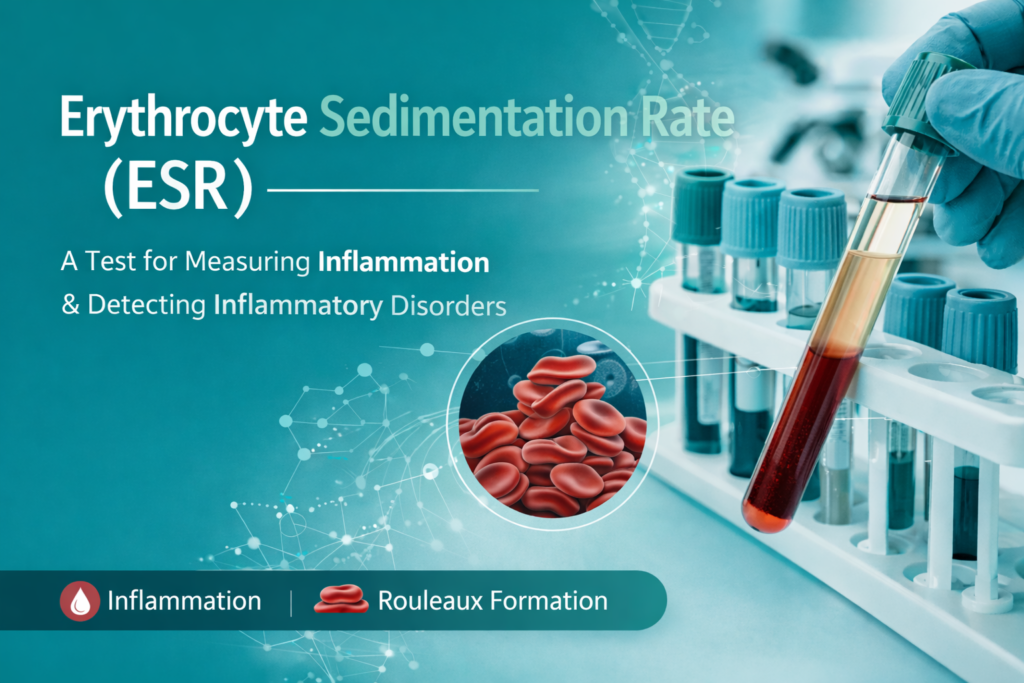
Table of Contents
Definition
The ESR test is a simple yet vital laboratory measurement that tracks how quickly red blood cells (erythrocytes) settle at the bottom of a specialized vertical tube over exactly one hour. In the lab, we use this “sedimentation rate” as a non-specific indicator of inflammation.
How It Works: The Science of Sinking
In a healthy state, Red Blood Cells (RBCs) carry a negative electrical charge on their surface (known as the Zeta potential). This causes them to repel one another, much like like-ended magnets, keeping them suspended in the plasma.
1. The Inflammation Trigger
When your body faces an infection, autoimmune flare-up, or injury, the liver produces Acute-Phase Proteins (like Fibrinogen and Globulins). These proteins act as “neutralizers” to the RBCs’ negative charge.
2. Rouleaux Formation (The “Coin Stack” Effect)
Without their protective “repelling” charge, RBCs begin to clump together. They stack neatly on top of each other, a phenomenon known as Rouleaux formation.
3. The Result
Because these “coin stacks” are heavier and have a smaller surface-area-to-mass ratio than individual cells, they sink rapidly through the plasma.
Faster Sinking = Higher ESR = Higher likelihood of active inflammation.
Clinical Significance:
The ESR (Erythrocyte Sedimentation Rate) is often described as a non-specific marker. In laboratory medicine, we view it like a smoke alarm: it tells you there is a “fire” (inflammation) somewhere in the body, but it doesn’t tell you which room the fire is in.
Because it lacks “organ specificity,” we use it as a primary tool to detect and monitor the activity of inflammatory conditions over time.
Primary Clinical Applications
We typically monitor ESR to track the progress of:
Systemic Infections: Tracking how the body is responding to treatment.
Autoimmune Flare-ups: Measuring the intensity of conditions like Rheumatoid Arthritis or Lupus.
Chronic Inflammatory Diseases: Monitoring long-term management strategies.
The “Red Flag” Zone: ESR > 100 mm/hr
When a laboratory report shows an extremely high ESR—exceeedng 100 mm/hr—it is a significant clinical “Red Flag.” At Medlabify, we categorize these results as highly suggestive of specific, serious underlying conditions:
| Condition | Why the ESR is so high |
| Temporal Arteritis | Severe inflammation of the lining of your arteries (Giant Cell Arteritis). |
| Polymyalgia Rheumatica | An inflammatory disorder causing widespread muscle pain and stiffness. |
| Multiple Myeloma | A plasma cell cancer that produces massive amounts of abnormal proteins (paraproteins), causing extreme Rouleaux formation. |
| Severe Infections | Conditions like Tuberculosis or deep-seated bone infections (Osteomyelitis). |
Why Get Tested?
The Purpose of the ESR Measurement
While modern medicine has many advanced tests, the ESR remains a fundamental tool in the laboratory. It isn’t usually ordered to diagnose a specific disease, but rather to provide a broad “status report” on your body’s inflammatory state.
Here is why a clinician will typically request an ESR:
1. To Detect “Silent” Inflammation
Sometimes the body feels “off”—unexplained fatigue, low-grade fever, or general malaise—without a clear cause. The ESR acts as a screening tool to confirm if there is an underlying inflammatory process that isn’t visible on the surface.
2. To Monitor Known Conditions
For patients already diagnosed with chronic conditions like Rheumatoid Arthritis or Systemic Lupus Erythematosus (SLE), the ESR is a “progress tracker.”
Decreasing ESR: Indicates the treatment is working and inflammation is subsiding.
Rising ESR: May signal a “flare-up” that requires a change in medication.
3. To Investigate Specific Symptoms
An ESR is a high-priority test when a patient presents with:
Unexplained Joint Pain or Stiffness: Helping distinguish between inflammatory and non-inflammatory arthritis.
Chronic Headaches or Vision Changes: Specifically to rule out Temporal Arteritis, a serious condition that can lead to permanent vision loss if not caught early.
Persistent Fever or Weight Loss: Checking for hidden infections or malignancies.
4. To Differentiate Diagnostic Paths
In many cases, the ESR helps a doctor decide which specialist to refer a patient to next. If the ESR is normal, the cause may be mechanical or physical; if it’s high, it points toward a biological or systemic issue.
The Medlabify Perspective
“Normal doesn’t always mean healthy, and High doesn’t always mean sick.” > At Medlabify, we remind professionals that the ESR is a complementary test. It provides the most value when compared against other markers like CRP and, most importantly, the patient’s actual symptoms.
Quick Stats
| Feature | Details | Things You Need to Know |
| Test Type | Hematology / Inflammatory Marker | This measures the “speed of sinking”—it’s a physical measurement of how cells settle rather than a chemical count. |
| Sample Type | Routine Venous Draw | A standard blood draw usually taken from the arm. In the lab, we use either a Lavender (EDTA) or Black (Citrate) tube. |
| Fasting Required? | No | You do not need to fast. However, high-fat meals before the test can sometimes subtly alter plasma density and results. |
| Turnaround Time | 1–2 Hours | The standard “Westergren” manual method takes exactly 60 minutes. Automated lab systems can provide results in 20–30 minutes. |
| Category | Inflammatory Screening | Think of it as your body’s “smoke alarm.” It detects that a fire (inflammation) is present, even if it hasn’t been “located” yet. |
| Clinical Purpose | Monitoring & Red Flag Detection | Used to track autoimmune flare-ups (like RA or Lupus) and to catch serious issues like Temporal Arteritis or Multiple Myeloma. |
| Core Metrics | Sedimentation Rate (mm/hr) | The test measures how many millimeters (mm) the red blood cells fall in one hour. A higher number usually means more inflammation. |
ESR Reference Ranges (Westergren Method)
| Category | Age Group | Normal Range (mm/hr) | Clinical Note |
| Men | < 50 years | 0 – 15 | Lower due to higher hematocrit levels. |
| Men | > 50 years | 0 – 20 | Natural increase with age. |
| Women | < 50 years | 0 – 20 | Slightly higher baseline than men. |
| Women | > 50 years | 0 – 30 | Reference increases post-menopause. |
| Children | Puberty | 3 – 13 | Stable throughout childhood. |
| Newborns | 0 – 30 days | 0 – 2 | Very low due to high red cell mass. |
Clinical Alert Thresholds
While “Normal” varies, we use these specific markers for Reports Analysis on the site:
| Result Level | Value (mm/hr) | Common Clinical Associations |
| Normal | Within range | Healthy state or non-inflammatory condition. |
| Mild Elevation | 20 – 40 | Pregnancy, aging, or localized infection. |
| Moderate | 40 – 70 | Rheumatoid Arthritis, Chronic Infections. |
| Extreme High | > 100 | Red Flag: Myeloma, Temporal Arteritis. |
FAQs
1.Question : Is a high ESR always a sign of disease?
The Medlabify Answer : No. While a high ESR indicates inflammation, it can also be raised by “physiological” factors like pregnancy, menstruation, or simply aging. It is a signal to investigate further, not a final diagnosis.
2.Question :Why is my ESR high but my CRP is normal?
The Medlabify Answer : The ESR is a “slow” marker. It takes days to rise and weeks to fall. CRP (C-Reactive Protein) responds much faster. If your ESR is high but CRP is normal, you may be at the very beginning or the very end of an inflammatory episode.
3.Question :Can exercise affect my ESR results?
The Medlabify Answer : Intense physical activity can temporarily increase inflammation markers. For the most accurate “baseline” reading, it is best to avoid heavy exercise right before your blood draw.
4.Question :Does anemia affect the ESR?
The Medlabify Answer : Yes. Anemia is one of the most common causes of a “false high” ESR. With fewer red blood cells in the tube, there is less upward resistance, allowing the cells to fall much faster through the plasma.
5.Question :Why is the Westergren method preferred over Wintrobe?
The Medlabify Answer : The Westergren method uses a taller tube (300mm vs 100mm), which allows for a more sensitive reading of highly elevated rates. It is considered the “Gold Standard” in modern clinical laboratories.
6.Question :Can a “Normal” ESR rule out cancer?
The Medlabify Answer : Not entirely. While many cancers (like Multiple Myeloma) cause a very high ESR, some early-stage or localized tumors may not trigger enough systemic inflammation to raise the sedimentation rate.
7.Question :How long is an ESR sample stable in the lab?
The Medlabify Answer : For accurate results, the test should be started within 4 hours at room temperature. If refrigerated, it can stay stable for up to 24 hours, but must be brought back to room temperature before testing.